
What Could Climate Change Change?
Chapter 7 of my forthcoming book "How Economists Will Destroy Capitalism"

The key concern for climate scientists is that increases in global average temperature could cause critical features of the climate to tip from states which have enabled human sedentary societies to evolve, into states which could destroy them. Some of these tipping points, and some of the challenges they present, are well-known—the Greenland Ice Sheet, for example, could raise sea levels by up to seven meters, if it melted completely.
However, that change would take “centuries to millennia” to occur {Lenton, 2023 #7201`, Table 1.2.1`, p. 59}, which makes it sound far distant, not at all threatening to people alive today, and something to which we could adapt to over time.
There are, however, other potential “tipping points” which could transit from civilization-enabling to civilization-destroying states in your lifetime. This chapter details three of them, not because they are likely, but because they illustrate what climate change actually means. I hope understanding these phenomena, which global warming could feasibly trigger, will make it easier to understand how a rise in average global temperature of just a few degrees could destroy our sedentary civilization.
None of these are potential events is, as yet, a consensus prediction in climate change research—though research and data has shifted the first from a low to a high probability during the 21st century {van Westen, 2024 #7416;Pontes, 2024 #7421;Ditlevsen, 2023 #7402}. However, all of them are the sorts of changes for which cost-benefit analysis is irrelevant: you simply should not allow any possibility of them happening. And yet they could happen on the current trajectory of global warming.
1. Termination of the “Atlantic Meridional Overturning Circulation”
The “Atlantic Meridional Overturning Circulation” (AMOC) is the Atlantic segment of an enormous circulation system, known as the Thermohaline Circulation (THC), which spans all of the Earth’s oceans—see Figure 2.
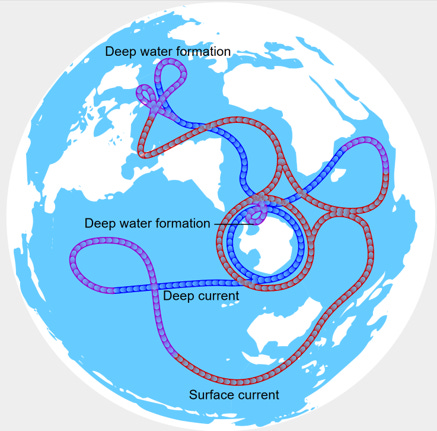
Figure 2: : An animation of the Thermohaline Circulation on Wikipedia at https://upload.wikimedia.org/wikipedia/commons/a/ab/Thermohaline_circulation.svg
The volume of water transported by the AMOC is hard for the human mind to comprehend. The unit of measurement that oceanographers use for the movement of water is called a Sverdup, and it corresponds to water moving through a cross section with an area of one million square metres—think of a square one kilometre on each side, or a pipe with a diameter of more than 1.1 kilometres—at a speed of one metre per second.
The discharge of all the world’s rivers into the planet’s oceans is equivalent to about 1.5 Sverdups. The AMOC moves about ten times this volume of water from the South Atlantic to the North as warm relatively fresh water near the surface of the ocean, and an equivalent volume of cold, salty water flows back in its depths. The amount of energy transferred is also near incomprehensible to the human mind: the heat the AMOC transfers makes the North Atlantic, and continental Europe, about 10°C warmer than they would otherwise be.
The AMOC has shut down over palaeontological timescales, but initial research into the stability of the AMOC implied that this would be unlikely to happen on a human time scale. Lenton’s 2008 survey—the one that Nordhaus so utterly misinterpreted—suggested that it would take between 3°C and 5°C of warming to cause it to shut down, and that the transition would take of the order of a century {Lenton, 2008 #5678`, Table 1`, p. 1788}.
Unfortunately, more recent research suggests that the AMOC could be turned off by as little as 1.1°C of warming {Lenton, 2023 #7201`, Table 1.4.1`, p. 125}, which we have already exceeded, and that the transition could result in European temperatures falling by more than 9°C over a mere three decades:
Atmospheric and sea-ice feedbacks, which were not considered in idealized climate models studies, further amplify the AMOC-induced changes, resulting in a very strong and rapid cooling of the European climate with temperature trends of more than 3°C per decade. {van Westen, 2024 #7416`, p. 7}
If this happened, then large sections of Northern Europe would become uninhabitable, not because of heat, but because of cold—while the rest of the planet would warm by an equivalent amount, though over a much larger area.
The timeline for this possibility has declined from centuries, in Lenton’s 2008 survey, to years in the most recent research. The most troubling research implies that this process could occur at any time between 2025 and 2095:
In this work, we show that a transition of the AMOC is most likely to occur around 2025-2095 (95% confidence interval). {Ditlevsen, 2023 #7402`, p. 2}
If it did, then quite possibly within your lifetime, much of northern Europe would become uninhabitable, while temperature volatility and a dryer climate would make much of the remainder of Europe both unliveable, and unable to feed itself:
The abrupt weakening or collapse of the AMOC would result in a climatic shift with profound regional, and even global, implications. Europe would become colder and drier, which would reduce agricultural productivity and render most land unsuitable for arable farming. {OECD, 2021 #6552`, p. 110}
If the AMOC tips, then the refugee crisis from global warming would not be one of Africans trying to cross into Europe, but of Europeans trying to cross into Africa. How well do you think they would be received, given how Europe is currently treating refugees from Africa?
Unfortunately, what happens in Northern Europe will not stay in Northern Europe. As well as causing a near-Ice-Age event in northern Europe, modelling by Lenton for the OECD implied that the combination of 2.5°C of global warming, and the loss of the AMOC, would result in a 70% fall in the proportion of the globe’s land area that is suitable for growing corn and wheat {OECD, 2021 #6552`, Figure 3.20`, p. 153}.
an AMOC collapse would clearly pose a critical challenge to food security. Such a collapse combined with climate change would have a catastrophic impact. {OECD, 2021 #6552`, p. 152}
A 70% fall in grain output would cause a global famine that would kill of the order of half the world’s population, even without taking into account the military conflicts that such a catastrophe would trigger.
