
Accounting for money
Chapter 12 of my forthcoming book "How Economists Will Destroy Capitalism"

Most people who haven’t studied economics expect economists to be experts on money because, hey, isn’t that what economics is about?
Instead, one of the peculiarities of Neoclassical economics is that it assumes that money doesn’t matter, apart from the impact of money growth on the rate of inflation. The real level of output—the volume of goods and services created by the production system—is assumed to be unaffected by the money supply, the banking system, or the level of private debt. Consequently, Neoclassical macroeconomic models completely omit the banking system: neither banks, nor private debt, nor money, figure in mainstream “Dynamic Stochastic General Equilibrium” (DSGE) models.61F[1]
The models of money and banking that Neoclassical economists do have—the “Money Multiplier/Fractional Reserve Banking” model of money creation, and the “Loanable Funds” model of bank behaviour, are not serious models of money and banking, but excuses to not include banks, money, and private debt in their models of the macroeconomy. Though Neoclassicals will never admit it, their models fall apart with the least inspection of what they imply in double-entry bookkeeping form (brace yourself: some accounting logic is coming).
On the other side stands a rival tradition dating back over a century, which argues that banks, debt and money play critical roles in a capitalist economy. Neoclassical economists have, of course, ignored this tradition—even when one of their own, Irving Fisher, ultimately contributed to it, with his explanation for The Great Depression.
In “The Debt-Deflation Theory of Great Depressions” {Fisher, 1933 #152} Irving Fisher asserted that the Great Depression was caused by a combination of too much private debt,62F[2] and too low a rate of inflation:
I venture the opinion, subject to correction on submission of future evidence, that, in the great booms and depressions, each of the above-named factors has played a subordinate role as compared with two dominant factors, namely over-indebtedness to start with and deflation following soon after… {Fisher, 1933 #152`, pp. 340-41}
Fisher dubbed the ensuing process a “debt-deflation”. Starting from a position of generalised over-indebtedness, debtors attempt to attract business to themselves, rather than their rivals, by dropping their prices. But because virtually everyone is doing it, the price level drops, and the ratio of private debt to GDP actually increases:
In that case, the liquidation defeats itself. While it diminishes the number of dollars owed, it may not do so as fast as it increases the value of each dollar owed. Then, the very effort of individuals to lessen their burden of debts increases it, because of the mass effect of the stampede to liquidate in swelling each dollar owed. Then we have the great paradox which, I submit, is the chief secret of most, if not all, great depressions: The more the debtors pay, the more they owe. {Fisher, 1933 #152`, p. 334}
The empirical data supports Fisher’s contention. According to US Census data, the nominal level of private debt peaked in 1932, but the ratio of private debt to GDP peaked 2-3 years later, because nominal GDP fell faster than nominal debt: see Figure 9. The burden of private debt was rising between 1930 and 1933, even though the level of debt was actually falling—see Figure 9.
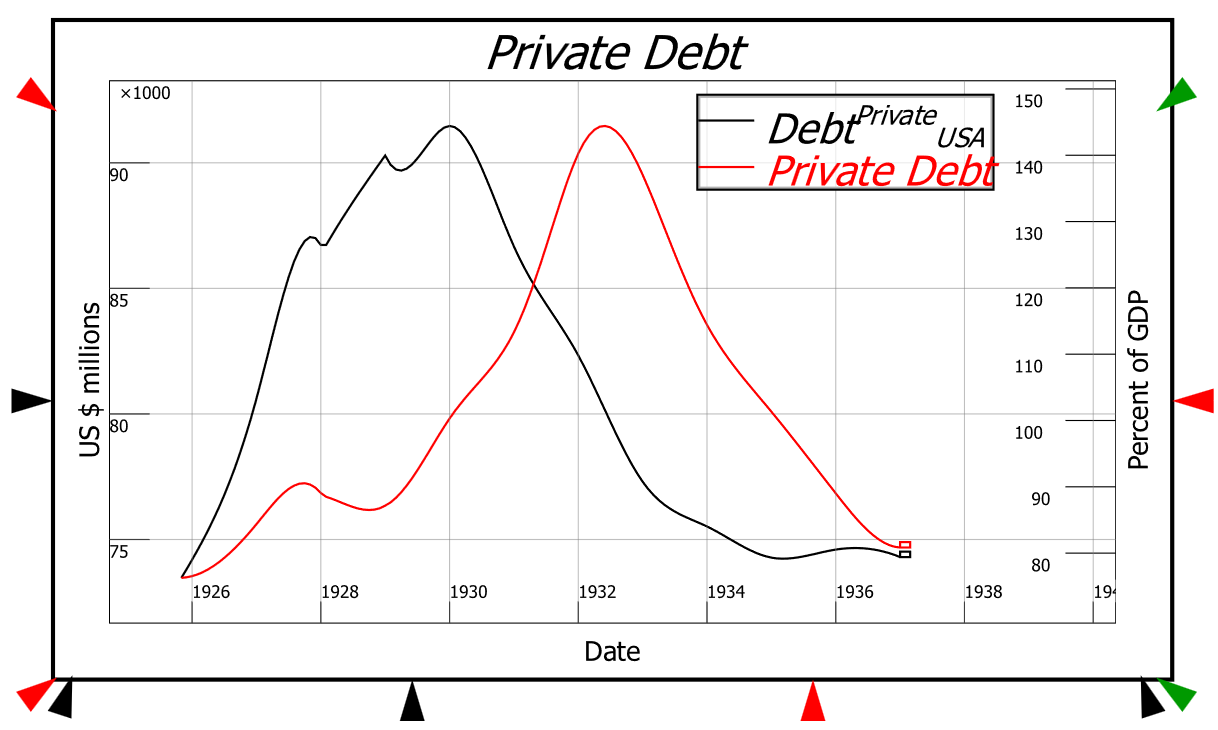
Figure 10: The private debt ratio rose from 1930 to 1932 (right hand axis), even as nominal debt was falling (left hand axis)
A critical part of Fisher’s analysis was that repaying bank debt destroyed money:63F[3] “when a debt to a commercial bank is paid by check out of a deposit balance, that amount of deposit currency simply disappears”. Fisher clearly stated that this was a consequence of bank lending, not of “peer-to-peer” lending: “A man-to-man debt may be paid without affecting the volume of outstanding currency, for whatever currency is paid by one, whether it be legal tender or deposit currency transferred by check, is received by the other, and is still outstanding”.
Speaking as a representative of Neoclassical economists, Ben Bernanke explained that they ignored Fisher’s arguments… because of the characteristics of peer-to-peer lending:
